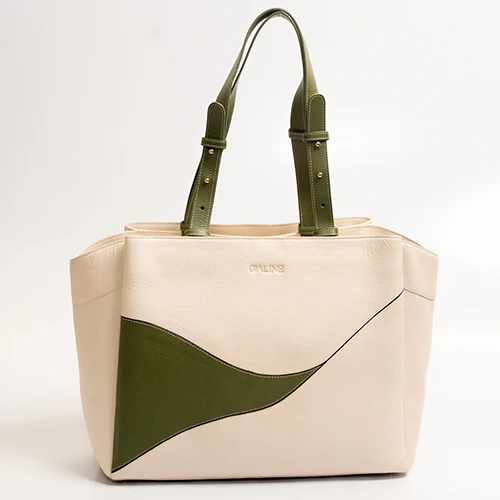

Full Grain Leather vs. Top Grain Leather: A Complete Guide
There's a particular satisfaction in running your fingers across quality leather. The subtle grain, the weight of it, the way it seems to improve with time.
Not all leather is created equal. In a market crowded with vague terms like “genuine leather” it’s important to know what you're investing in. Especially when you're looking for the types of bags that can carry you through a work day and carry your essentials: laptop, documents, the emergency makeup pouch.
Full Grain vs. Top Grain Leather: The Leather Hierarchy
Leather exists on a spectrum. At the very top sits full grain leather, followed closely by top grain. Below that, you'll find corrected grain, split leather, and bonded leather. But we're not here to discuss those. When you're choosing between the types of bags that will genuinely serve you for years, the conversation begins and ends with full and top grain.
Full grain leather
Exactly what it sounds like, full grain leather means the complete grain structure of the hide is left entirely intact. Nothing has been sanded away, buffed down, or artificially altered. You're looking at the outermost layer of the hide with all its natural characteristics, marks, scars, or imperfections.
This kind of leather ages beautifully, developing that coveted patina that makes vintage bags so desirable.
Related: Full Grain Leather Daypack - Moss Green

Top grain leather
Top grain has had its surface lightly sanded or buffed to remove imperfections. A finish is then applied to create a more uniform appearance. It's still high-quality leather, but it's been refined to look more consistent.and is considered the second-best option. .
The Full Grain Difference
What makes full grain leather the gold standard is density. Because the surface hasn't been compromised, all those tightly woven fibers remain intact. This makes full grain leather handbags extremely durable.
The natural grain also means each piece is unique. Subtle variations in texture and tone are proof of authenticity. Know that when you carry a full grain leather handbag, you’re carrying something with character from day one, that will continue to tell its own story as you use it. The patina that develops is perhaps full grain's most compelling feature. Unlike bags that simply look worn after a few years, full grain leather darkens and softens in a way that feels intentional. The spot where you grip the bag while on your commute, the handles, develop a rich lustre that can't be replicated artificially.
Full grain leather is breathable, because it allows air circulation, which means your bag (and its contents) are less likely to develop that slightly musty smell that can plague synthetic alternatives or lower-quality leather.

Related: Opaline deep wine wristlet pouch
Where Top Grain Leather Has Its Place
Top grain leather often gets positioned as the runner-up, but that's not entirely fair. For certain bag designs top grain can be a smart choice.
The buffing process creates a consistent surface, which means predictable results in terms of colour and texture. If you're someone who finds the natural variations in full grain too rustic, top grain offers that refined, polished look straight out of the box.
It's also more resistant to stains and spills. The protective finish creates a barrier that makes the leather easier to maintain. For a work bag that's going to encounter coffee shops, restaurant tables, and the occasional unexpected rain shower, it’s practical.
Price-wise, top grain typically comes in lower than full grain, though we're still talking about premium leather.
Why Opaline Chooses Full Grain Leather

At Opaline, the choice to use full grain leather for our work bags is deliberate. Long lasting quality is our north star. So, unlike fast fashion that looks great for a season but ends up in landfills after, we choose premium full grain which is built to last and suits the dynamic needs of the modern working Indian woman.
While the cost of full grain leather might seem significantly higher at first glance, a full grain leather handbag is truly an investment that stands the test of time. Each piece from Opaline is made with the highest quality leather that holds structure, improves over time, has the durability to handle long work days and keeps your valuables protected, always.
Artificial Leather vs. Real Leather: Texture, Feel, and Appearance Differences
Let's address something that often goes unspoken in polite retail conversations: the gap between artificial and real leather.
The touch test
A real leather piece is as unique as a fingerprint. Run your hand across genuine leather, whether full grain leather or top grain, and you'll notice a subtle irregularity. Real leather has a slightly uneven texture, minute variations that your fingertips register even if your eyes don't immediately catch them. It's organic, so it lacks the mechanical precision of manufactured materials.
Artificial leather, no matter how sophisticated, feels uniform. Perfectly consistent. That's actually its tell. The texture repeats in patterns because it's printed onto a synthetic base. Place two artificial leather bags side by side, and you'll often notice the grain pattern matches exactly.
Real leather adjusts to ambient temperature relatively quickly and feels warm to the touch. Artificial leather tends to feel cooler initially and takes longer to warm up.
The weight difference
Real leather has substantial weight. You feel it when you pick up the bag. This heft comes from the density of the hide and prevents the bag from sagging and losing shape over time.
Artificial leather is essentially plastic layered onto fabric backing, so it can be engineered to various weights. Higher-end versions might approximate the weight of real leather, but budget options feel noticeably lighter and, frankly, cheaper.
Visual distinctions
Artificial leather has become remarkably convincing at first glance. Premium versions can fool even experienced eyes in controlled lighting. But there are tells.
Look at the bag's edges. Real leather looks organic and fibrous, like examining thick paper torn rather than cut. Artificial leather shows separate layers—fabric underneath, plastic on top. Real leather has depth: the way light catches isn't uniform because the surface isn't perfectly flat at a microscopic level. Artificial leather, by contrast, tends toward either a flat matte finish or an exaggerated shine.
What to Look For in a Quality Bag Design

Regardless of whether you choose full or top grain, know that quality leather is just the start. How the bag is built matters equally.
Stitching should be tight, even, and ideally done with waxed or nylon thread that won't deteriorate. Look at stress points, where the handles attach, along the bottom seams. This is where cheaper bags fail first.
Hardware can make or break your everyday experience. Zippers should move smoothly without catching. Metal shouldn’t feel hollow or lightweight. Quality hardware isn't just about durability, but the daily experience of using your bag.
Interior organization is where thoughtful design reveals itself. A well-conceived tote bag design or daypack helps you stay organized. Look for interior pockets sized for the things you carry: your phone, laptop, cosmetics case, keys.
The base should be structured enough to maintain shape even when the bag isn't full. There's nothing more frustrating than a beautiful leather handbag that collapses in on itself the moment you set it down.
Leather vs. Synthetic Leather: The Long-Term Game
Let's talk about cost per wear, because that's the real measure of value. The cost of replacing and throwing away fast fashion is huge, not just for your wallet but also the environmental cost.
A well-made full grain leather tote might cost more upfront. But when you consider using it daily for five, ten, even fifteen years, the mathematics shift dramatically.
“I’m still using my full grain leather wallet that I bought 13 years ago.” says Swati Sinha, Founder, Opaline. “It's aged beautifully, and honestly, it's not just about getting your money's worth. Objects hold memory. This wallet has been with me through career changes, cities, milestones. You can't put a price on that.”
Frequently asked questions
What is full grain leather?
Full grain leather is the highest quality leather, using the complete, unaltered top layer of the hide with all natural grain intact. Nothing is sanded or buffed away. It's the most durable option, breathes well, and develops a rich patina over time. Each piece has unique natural markings.
What is top grain leather?
Top grain leather is the second-highest quality leather. The surface has been lightly sanded or buffed to remove imperfections, then finished for a more uniform appearance. It's still durable and high-quality, more stain-resistant than full grain, but won't develop the same natural patina over time.
What’s the price difference between full grain and top grain leather ?
In India, full grain leather typically costs 30-50% more than top grain. The gap varies by brand, craftsmanship, and whether it's imported or domestically produced.
Which leather type lasts longer?
Full grain leather lasts longer because its surface remains intact with all natural fibers undisturbed; this makes it exceptionally durable. While top grain is also long-lasting, the sanding process slightly weakens the leather's structure. Full grain actually improves with age, developing strength and character over decades of use.
What to do immediately if a leather bag gets wet?
Gently blot excess water with a soft, absorbent cloth. Don't rub. Let the bag air dry naturally at room temperature, away from direct heat or sunlight. Stuff it with newspaper or tissue to maintain shape while drying. Avoid using hairdryers or radiators, as heat can crack and damage the leather permanently.